The study and practice of international law have historically been dominated by Euro-American perspectives and institutions. While these traditions have contributed significantly to the development of the international legal system, they often marginalize or overlook the experiences, interests, and intellectual contributions of non-Western societies.
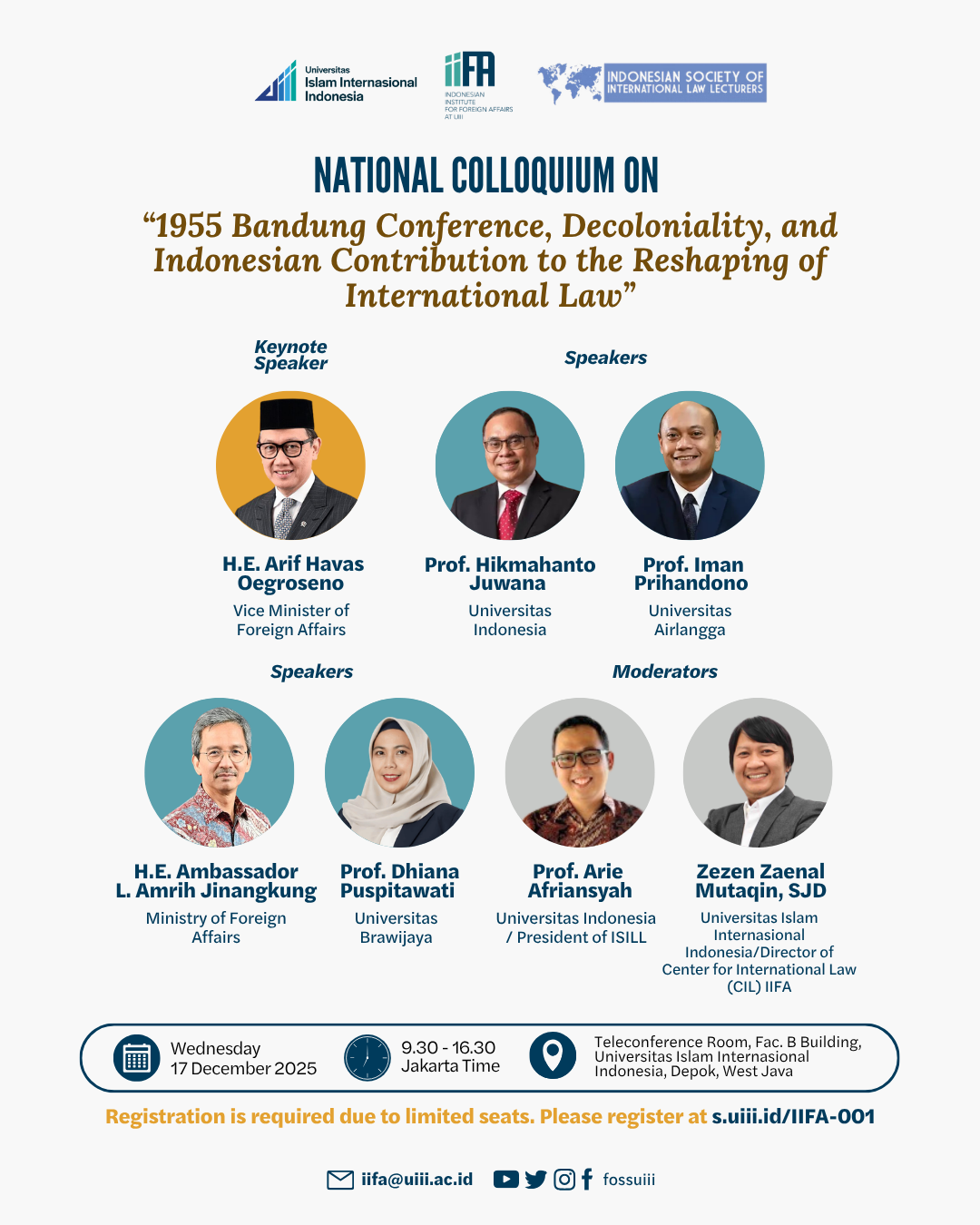
Indonesia, as the world’s fourth most populous country, the largest Muslim-majority democracy, and a founding member of key international organizations such as ASEAN, and Non-Alliance Movement (Non-Block), has played an important role in shaping global legal and political norms. From the Bandung Conference of 1955 to its contemporary engagement in multilateral diplomacy, Indonesia has contributed distinct perspectives to international law, particularly in advancing principles of sovereignty, self-determination, non-alignment, and equitable development.
The establishment of a Center for International Law within the Indonesian Institute of Foreign Affairs will provide a platform to critically study the international legal system from non-Western perspectives, amplify Indonesia’s contributions, and generate innovative scholarship and policy recommendations that reflect Indonesian values and priorities.
Vision:
To become a leading hub for the study and development of international law rooted in non-Western perspectives, with Indonesia at the forefront of shaping just, inclusive, and equitable global norms.
Mission:
- To conduct research on the historical and contemporary development of international law from Asian, African, and Global South perspectives.
- To document and analyze Indonesia’s contributions to the formation and evolution of international legal norms.
- To provide policy recommendations to strengthen Indonesia’s role in international lawmaking and norm entrepreneurship.
- To promote academic exchange and dialogue between Indonesian and international scholars, practitioners, and policymakers.
Research Priorities
- Norms and Systems of International Law from Non-Western Perspectives
- Comparative studies on the development of international law in Asia, Africa, and the Global South.
- Critical engagement with Third World Approaches to International Law (TWAIL).
- Indigenous, regional, and religious contributions to concepts of justice, sovereignty, and order in international relations.
- Indonesia’s Contribution to International Law
- Historical role in Bandung Conference and Non-Aligned Movement.
- Indonesian perspectives on sovereignty, territorial integrity, and maritime law (UNCLOS and archipelagic state doctrine).
- Contributions to human rights, humanitarian law, environmental law, and sustainable development.
- Role in ASEAN legal frameworks and South-South cooperation.
- Contemporary Challenges and Opportunities
- Reform of global governance institutions (UN, WTO, IMF, World Bank).
- Climate change, environmental justice, and sustainable development law.
- Cybersecurity, digital sovereignty, and new frontiers in international law.
- Peace, security, and humanitarian intervention from Global South perspectives.
Activities
- Research Projects: Thematic studies on identified priority areas.
- Policy Briefs: Evidence-based recommendations for Indonesian foreign policy.
- Conferences & Workshops: Regular forums bringing together scholars, diplomats, and practitioners.
- Capacity Building: Training programs for young diplomats, students, and researchers.
- Publications: Working papers, academic articles, and policy-oriented reports.
- Networking & Partnerships: Collaboration with national, regional, and global research institutions.